
Notes From the AI Wave # 20
For decades, building a new AI model looked like a one-way street: humans wrote the code, cleaned the data, ran the training, and shipped the model.
That just changed.
Check out these statements from the 2 leading AI Builders – OpenAI and Anthropic.
Regarding OpenAI.
In February 2026, OpenAI publicly said something that would’ve sounded like science fiction a few years ago: GPT-5.3-Codex was “instrumental in creating itself.”
OpenAI explained that early versions of the model helped the team debug its own training, manage deployment, and diagnose tests and evaluations.
Let that sink in for a moment:
Building an AI model is like building a rocket.
You run thousands of experiments.
You constantly hit bugs, weird results, and confusing performance drops.
Now, the AI can help engineers find the bugs, explain what went wrong, and even help ship the software that runs the system.
So did GPT-5.3-Codex literally “train itself” from scratch?
No. Humans still choose goals, design training, decide what data is used, and press the big red “go” button.
But the model is now part of the toolchain that creates the next version of itself—and OpenAI is explicitly saying so.
What about Anthropic?
Anthropic doesn’t say “Opus 4.6 built itself” in the same direct way.
But in its published materials, Anthropic makes a closely related point: Claude Opus 4.6 is used heavily inside Anthropic for coding and data generation.
That matters because “coding and data generation” are consequential pieces of the AI-building pipeline.
If the model is writing chunks of code and helping generate training-style data, it’s not just a product anymore—it’s also part of the factory.
Anthropic’s launch post also frames Opus 4.6 as better at long, careful planning and working reliably in large codebases—exactly the kind of work you’d want from an assistant helping build complex systems.
Here’s where we are:
We’re entering a world where the tools used to build AI include AI itself.
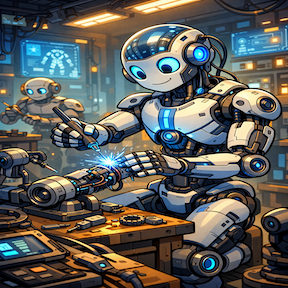
The robot isn’t fully self-made—but it’s starting to help assemble the next robot.
And once that loop starts, progress will speed up in a very intense way.
Are you ready?